Recovery guide
TPLO surgery recovery for dogs: a week-by-week guide
What to expect after TPLO surgery for a torn CCL, how to set up your home, and a printable daily checklist for the long rest period.
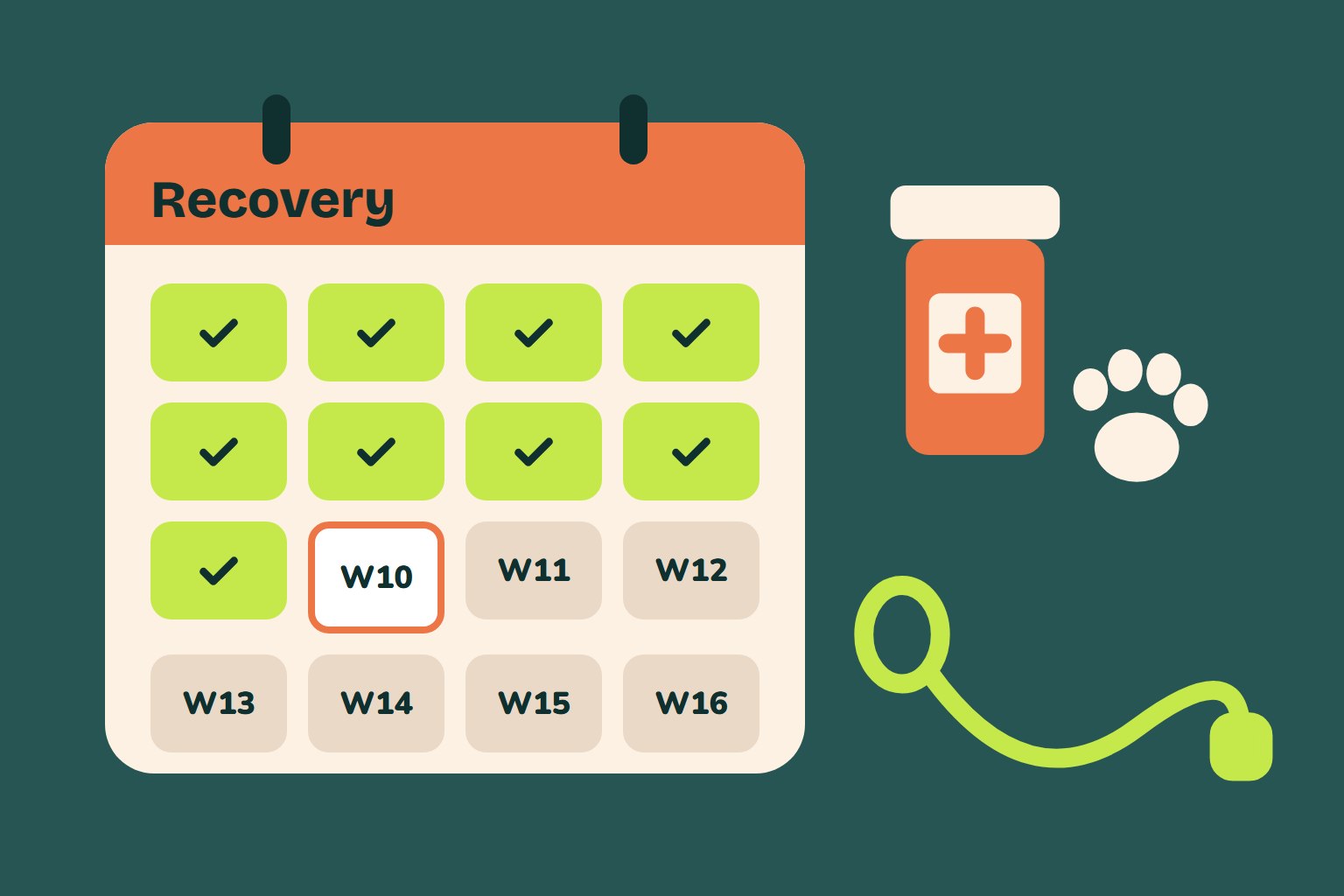
A torn CCL (the dog version of a torn ACL) is one of the most common knee injuries in dogs, and TPLO surgery is one of the most common fixes. The surgery is the quick part. The recovery takes about four months, and most of it happens at home, on your watch.
Here’s what that usually looks like, week by week, plus how to set up your house and a checklist you can print and stick on the fridge.
Week by week
Days 1–14: strict rest
- Keep your dog in a crate, pen or one small room with good footing. No free run of the house.
- Potty breaks on a short leash only, a few minutes at a time. A sling or towel under the belly helps them balance.
- Give pain medicine and anti-inflammatories exactly as prescribed, on time.
- Check the incision every day. A cone or recovery suit stays on until the stitches come out, usually around day 10 to 14.
- If your vet says so, ice the knee for 10 to 15 minutes a few times a day for the first few days.
Weeks 2–8: short, slow leash walks
- Still no running, jumping, stairs, furniture, off-leash time or rough play.
- Short leash walks, often starting around 5 to 10 minutes, a few times a day. Add a few minutes each week as your vet directs.
- Do any rehab exercises your vet gives you, like slow sit-to-stands. Some clinics offer underwater treadmill sessions.
- Most dogs start putting weight on the leg within the first couple of weeks and use it more each week after that.
Around week 8: the recheck
Most surgeons take x-rays around 8 weeks to make sure the bone has healed. This is usually the green light to start increasing activity.
Weeks 8–16: building back up
- Longer walks, then gentle hills, a little at a time.
- Off-leash play and running come back last, only once your vet clears it. Many dogs are back to normal around 4 to 6 months.
Set up your house before surgery day
- One recovery room with a comfy bed, water and nothing to jump on. An exercise pen works well.
- Grippy floors. Put non-slip rugs or runners over hardwood and tile, especially where your dog walks to get outside.
- Block the stairs and furniture with baby gates, and plan how you’ll lift your dog into the car, or use a ramp.
- A support sling for the first weeks of potty trips.
- Cone or recovery suit so they can’t lick the incision.
- Brain games. A bored dog on rest gets restless. Lick mats, snuffle mats and frozen treat toys tire them out without moving the knee.
We may earn a small commission if you buy through these links. These are the kinds of things we’d look for, not products we’ve tested.
- Rear support sling
- Recovery suit (an alternative to the cone for many dogs)
- Non-slip rug runner
- Exercise pen
- Car ramp
- Lick mat and snuffle mat
Call your vet if you see
- Redness, swelling, heat, oozing or an opening at the incision
- Your dog suddenly stops using the leg, or gets worse instead of better
- Not eating, vomiting, diarrhea or unusual tiredness
- Licking or chewing at the incision that you can’t stop
The daily checklist
The hardest part is consistency: meds on time, the same short walks, every single day for weeks. Print this, and check things off as you go.
Fuzzbucket app
Every day
- Morning meds given
- Evening meds given
- Incision checked: clean, dry, no swelling
- Cone or recovery suit on
- Potty breaks on a short leash only
- Walk minutes, exactly what the vet said: ______
- Rehab exercises done (if prescribed)
- A brain game: lick mat, snuffle mat or frozen treat toy
Not yet
- No stairs, jumping, furniture or car jumps
- No running, off-leash time or rough play
Dates to remember
- Surgery date: ______
- Stitches out: ______
- 8-week x-ray recheck: ______
One more thing: the other knee
Many dogs who tear one CCL eventually tear the other one. Keeping your dog lean, and building strength back slowly, gives that other knee its best chance.